
Staff Doors Are Not The same
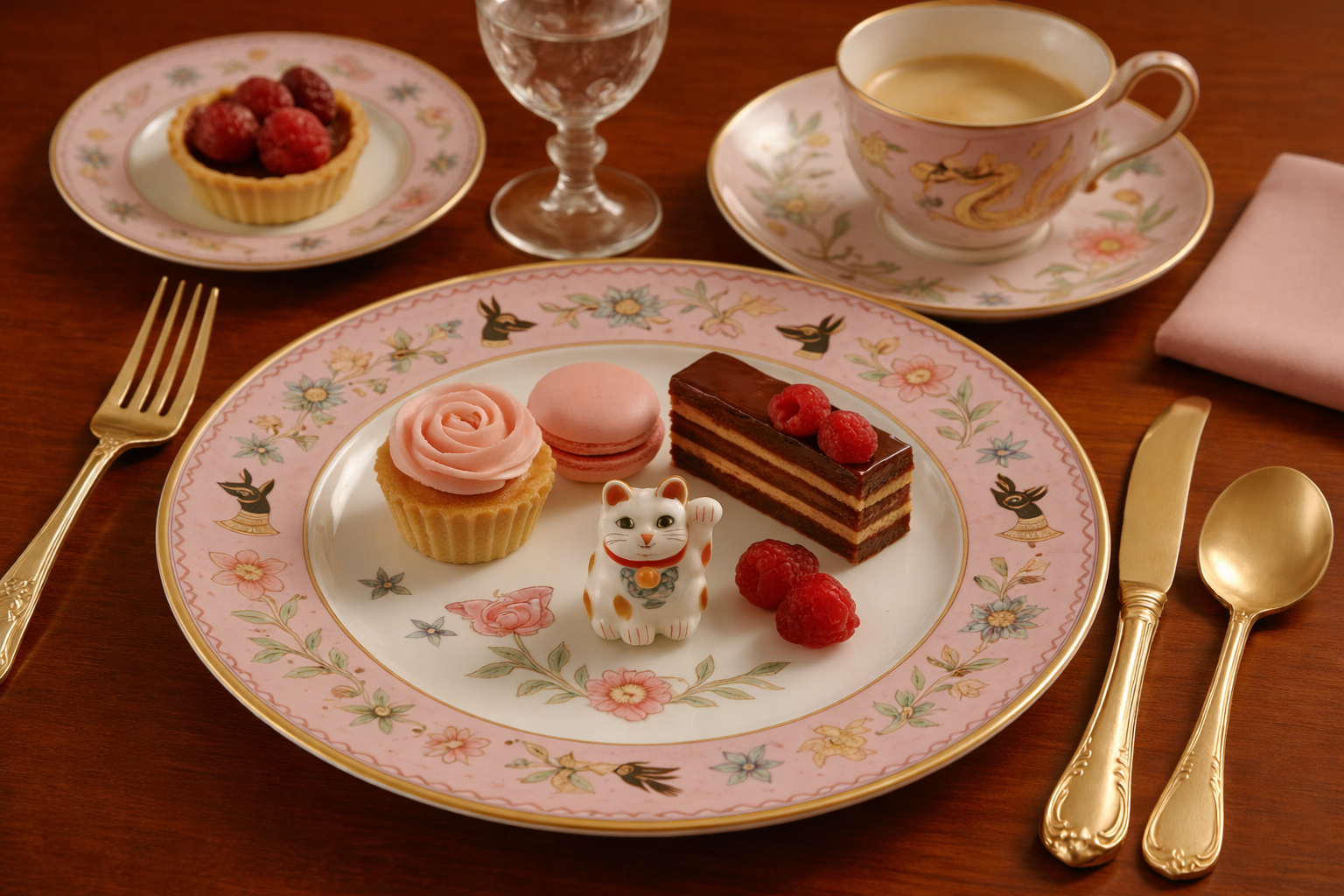
The cakes arrived still warm.
This would not have been remarkable, except that I had ordered nothing, and the room had not yet decided which century it preferred. The fire was laid but unlit. The lamps wore their yellow glow like borrowed jewelry. Outside the tall windows, dusk lingered in a shade I have only ever seen in photographs hand-tinted by someone with opinions.
The knock did not come.
The tray was simply present — poised on the low table between the sofa and the portrait of the woman who has lately taken to looking amused.
Six tea cakes, iced with a restraint that suggests Paris. Not the Paris of horse-drawn carriages or revolutions, but the other one — the one with clean glass cases and stainless steel counters, where the éclairs are aligned with moral precision and the macarons behave themselves.
These cakes were unmistakably modern. Their glaze caught the lamplight in a way that spoke of refrigeration and calibrated ovens. Their fruit fillings were bright with a confidence that did not exist before citrus could be persuaded to cross borders overnight.
They were arranged on porcelain dessert plates from the early nineteenth century.
The porcelain was thin enough to threaten disappearance. Each plate bore a delicate wreath of hand-painted violets and a rim so fine it might have been drawn with a single hair. I lifted one and felt the faintest warmth in the glaze — as though it had just emerged from a kiln.
The stamp beneath it declared 1823.
The edges were immaculate. No cracks. No history. Not even the courtesy of a chip.
New antiques are always unsettling.
I selected a cake dusted with powdered sugar so fine it could have been mistaken for frost. The sponge yielded with obedient softness. A ribbon of apricot shone at its center — too vivid for any orchard that had ever known Napoleon.
The Hotel has never struggled with logistics.
I have, on previous visits, been served oranges out of season, newspapers reporting events not yet occurred, and a brand of mineral water that insists it is sourced from a spring discovered last year. The staff offer no explanation. They present what is required with the serene confidence of a magician who believes the trick beneath them.
The cakes tasted of modern France — butter that has read philosophy, flour milled by machines that hum quietly about efficiency. There was a whisper of vanilla so precise it felt measured by satellite.
Yet the fork I used belonged to another era. Its tines were slender and slightly uneven, shaped by a hand that had never heard of factories. The silver left a faint metallic echo on my tongue, reminding me that time is not a straight corridor but a set of adjoining rooms with poor signage.
I asked no one how the Hotel had procured them.
The portrait above the mantel tilted her head by a fraction. Or perhaps I imagined it. The chandelier trembled without wind. I have come to understand that the Hotel dislikes questions phrased too directly. It prefers admiration disguised as confusion.
On the second plate — stamped 1819 — a cake had been placed slightly off-center, as if in apology. I turned the plate over and found the glaze still soft beneath my thumb, barely cooled. The violet wreath had been painted with a steadiness uncommon in modern wrists.
The sugar on the cake had not yet settled.
Outside, a motorcar passed. I could hear it distinctly. Inside, the clock on the mantel ticked with the solemn gravity of something wound by hand each morning in 1804.
The two sounds did not argue. They coexisted.
This is the Hotel’s most alarming talent: it does not blend eras. It layers them. Like icing.
Halfway through the third cake — pistachio, with a sheen so green it bordered on impolite — I noticed a faint indentation on the opposite cushion of the sofa. It wasn’t there a moment ago.
Crumbs had fallen there before I dropped any.
The porcelain plates grew lighter as the cakes disappeared. I imagined them being formed in a kiln that had not yet been built, glazed by hands long gone, then shelved in a pantry that occupies no fixed address.
Somewhere in modern France, a pâtissier may have felt a brief chill while arranging éclairs in a display case. A momentary sense that something had been removed, not stolen, but borrowed across a seam in time. In it’s place, a utensil, hard to find, but back in fashion, may have appeared.
The Hotel is courteous about these things. It leaves no debt unpaid. It simply adjusts the ledger in ways that are difficult to audit.
When I reached for the last cake, I hesitated.
It was lemon. Sharp. Bright. Entirely inappropriate for a room dressed in velvet and oil paint.
I took a bite anyway.
The chandelier chimed softly. The motorcar sound dissolved into the clop of hooves. The clock on the mantel hiccuped and went backwards. The porcelain plate beneath my hand cooled decisively, settling into its declared year.
When I looked down again, the tray was empty.
Not cleared. Not removed. Empty in the way of something that had fulfilled its obligation.
The plates remained — pristine, new, and undeniably hand crafted.
I brushed a crumb from the table and found none.
The portrait woman’s hair was now red.
I have stopped asking how the Hotel manages these small oddities. It would be impolite. And besides, the tea cakes are always better when one does not inquire about the era of the kitchen they were procured from.
If you find yourself offered something impossibly fresh on something impossibly antique, accept it. Taste it carefully. Notice which sounds persist and which retreat.
The Hotel will be watching to see which century you swallow first.
~ A Diary Page Left Behind